Health Outcomes
Health Outcomes
Health Outcomes
Basic Income Experiments
Basic Income Experiments
About
Resources
Resources
Cost & Funding
The cost of implementing basic income in Canada largely varies from model to model. The Parliamentary Budget Officer (PBO), an independent and nonpartisan officer of Parliament, has estimated the implementation of a guaranteed basic income would cost $87.6 billion per year for all provinces in Canada. This report used the parameters set in the Ontario Basic Income Pilot. The Ontario pilot had given participants up to 75% of the low-income measure, roughly $16,989 for a single person and $24,027 for a couple. Individuals with a disability would get an additional $6000 per year. The benefit was reduced by $.50 for every dollar of employment earnings. The PBO’s report showed that Manitoba would benefit most from increased disposable income.
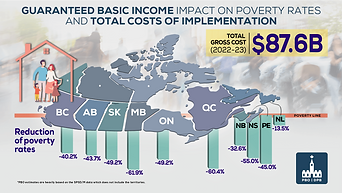
When the cost of guaranteed basic income was broken down, it showed that it would cost Manitoba $2.922 billion for the 2021-2022 fiscal year. That amount is not a lot, especially when Manitoba would greatly benefit from the program. The PBO’s report also showed a poverty rate reduction of 61.9%, greater than any other province in the country. There costs of the program can also be justified as there would be savings in education, justice, and healthcare.
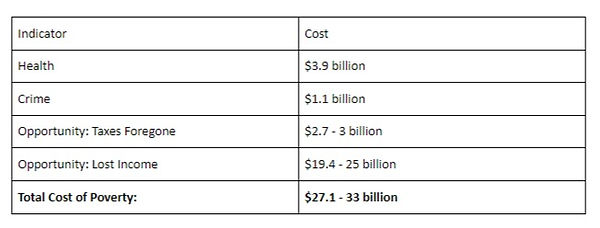
The cost of poverty in Canada also needs to be noted. According to a report from Feed Ontario titled The Cost of Poverty in Ontario, the cost of poverty in Ontario alone is between $27.1 and $33 billion. The data broken down is:
_edited.jpg)
Based on Feed Ontario's statistic's, I have estimated that the cost of poverty national-wide is between $69 and $84.07 billion. Poverty reduction in any part of Canada would result in massive savings for the country. Those savings could be reinvested into a basic income program.
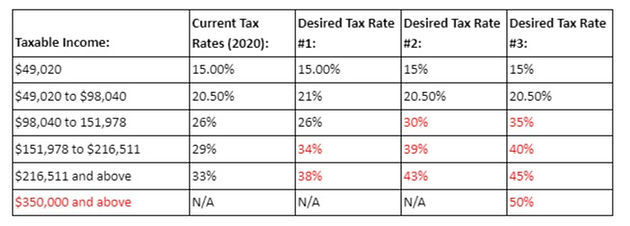
During my project, I also looked at increasing personal income tax rates in Canada using The Social Policy Simulation Database and Model (SPSD/M). I added an additional tax bracket for people making above $350,000 and increased the tax rate for some tax groups, mainly those who make above $98,040 per year. The tax rates I used were (changes are noted in red):
_edited.jpg)
_edited.jpg)
Calculated using The Social Policy Simulation Database and Model (SPSD/M)
Revenue from changes in federal personal income tax rates used above are shown below(number should be multiplied by 1,000,000):
If desired tax rate 3 is implemented, there would have been an additional $24,637.9 billion in personal income tax revenue. Looking at additional tax revenue and savings from reducing poverty in Canada shows that paying for a basic income program is possible. There would also be additional savings from the possible elimination of social assistance programs like the GST Credit provided to low-income Canadians. To me, it is clear that we can afford to pay for a basic income program. We also need to remember that there would be savings as a result.
The PBO report will be linked in the resources section of the website.