Health Outcomes
Health Outcomes
Health Outcomes
Basic Income Experiments
Basic Income Experiments
About
Resources
Resources
Basic Income Experiments
Current Basic Income Projects in Canada:
While many people often say a basic income (BI) is not possible in Canada, we need to note that we have two examples of BI currently, Canada Child Benefit and Old Age Security. Both programs provide near-universal benefits for individuals that fall within the age requirements.
Old Age Security (OAS) is a universal retirement benefit that is given to permanent residents of Canada that have lived in the country for a minimum of 10 years since their 18th birthday. Individuals are eligible to get the benefits once they hit their 65th birthday. Unlike the Canada Pension Plan, individuals are not required to pay in OAS as it is funded from tax revenues. The amount that is provided is based on five different categories:
-
Single
-
Married and both receiving OAS
-
Married with one partner receiving OAS and the other partner is under 60.
-
Married with one partner receiving OAS and the other partner between 60 and 64
-
Survivor of an OAS recipient, between 60 and 64
OAS also allows individuals to leave the country indefinitely and continue to receive the benefit as
long as they have lived in the country for 20 years between their 18th and 65th birthday.
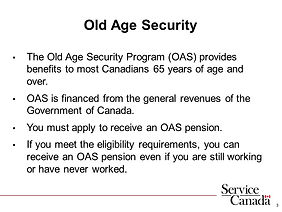
Like many supporters of a basic income advocate, this program is universal. Part of the success of
OAS is that it helped reduce poverty rates in Canada. Currently, seniors in Canada have some of the
lowest poverty rates among any group. It should also be noted that OAS is often provided in addition to other social assistance benefits and combined, they help bring seniors above the poverty line. Many supporters of BI have advocated for the benefit to be in addition to other social assistance programs as seniors benefits are currently.
The Canada Child Benefit (CCB)
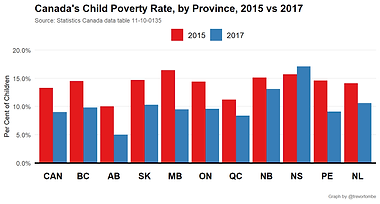
Like OAS, CCB is a form of BI. CCB provides families with a child between the ages of 0-18 with a monthly tax-free payment. This payment is a universal benefit that is provided as long as the family had filed taxes for the previous year. This payment is also tax-free. The amount that is received is dependent on the family's income level.
CCB has also helped reduce poverty rates in Canada, something many supporters of BI say will also occur. The CCB has allowed many families to stay above the poverty line who would otherwise be below it if they didn't receive the benefit. “In the 2017-2018 benefit year, the CCB has kept 277,000 families above the poverty line, defined as the Market Basket Measure (MBM) low-income threshold. Out of the 6.4 million Canadian children whose families receive the CCB, 9% would be below the poverty line without the income provided through the CCB or an alternative benefits program.”
Removing CCB would further cause many families to fall below the poverty line in Canada. Like a BI program, this additional income provides families with the opportunity to afford their basic necessities / needs.
How do both of them connect to basic income and each other:
Both CCB and OAS provide near-universal benefits to individuals within the required age groups. These social assistance programs are also in addition to other assistance programs. For example, OAS recipients can also receive the Canada Pension Plan and the Guaranteed Income Supplement. Receiving CPP is dependent on paying into the program and GIS is dependent on your income levels. Many supporters of a basic income, including myself, agree that a basic income program should be in addition to other social assistance programs. Only having a basic income program would continue to leave some Canadians behind and leave others without government benefits. Some benefits that would be removed with basic income replacing social assistance could be dental benefits, vision benefits, and the GST credit. Dental and vision benefits are provided by the provincial government and GST is a federal program.
Previous basic income projects:
There are two major basic income experiments that have been conducted in Canada, Mincome and the Ontario Basic Income Pilot. Both programs ended early because funding for the projects was ended early by their respective governments.
Manitoba Basic Annual Income Experiment (Mincome) was conducted between 1974 and 1979 in Winnipeg, rural Manitoba communities, and Dauphin. The Dauphin site was considered a control site for the experiment and only certain areas of Winnipeg were included. Funding for Mincome was given by both the Provincial and Federal governments. The program ended early because the new provincial government had removed its funding for the project. As the funding was reduced, the project had to come to an end and researchers on the project weren’t able to analyze the data when it had concluded in 1979.
Dr. Evelyn Forget analyzed the data from the experiment in 2011, Results from the Mincome experiment showed that:
-
Hospitalizations went down by 8.5%.
-
High school graduation rates went up
-
The standard of living went up, and economic security for Dauphin residents went up. (according to participants)
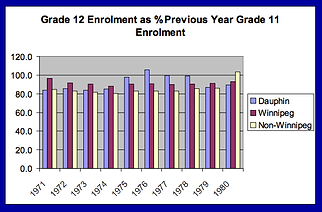
Image: Dr. Evelyn L. Forget
Many people point to Mincome and share that it didn’t help reduce unemployment rates and they are correct. However, many advocates for a basic income are not saying the basic income will help reduce unemployment. Individuals simply want to ensure that people have the means to have a decent standard of living. Mincome’s data had also shown that two groups of people reduced the amount of time they worked drastically, unattached males, and new mothers. Unattached males (teenage males, unmarried) reduced the amount of time they worked so they could complete high school. New mothers used Mincome to stay home longer with their new born children and extend their maternity leave.
Individuals in the Dauphin site had also stated that they chose to participate in the experiment because “it would be there if I needed it”.
The Ontario Basic Income Pilot was conducted from 2017 to 2019, the program was cancelled in 2018 but payments continued until 2019. Over 4000 people received the benefit and 2000 were in a comparison group. The pilot project was conducted in Hamilton, Brantford, Brant County, Thunder Bay, and Lindsay.
Results from the Ontario Basic Income Pilot showed that:
-
All individuals that received basic income report benefiting from it. Benefits included housing stability, food security, financial stability, and improvements in their mental and physical health.
-
Participants had fewer doctor and hospital visits and reported that it was easier for them to access prescription drugs. This provided savings for the healthcare system.
-
25% of recipients started an educational or training program.
Results from the pilot project and from Mincome showed that implementing a basic income would help reduce healthcare costs in Canada and help improve physical and mental health outcomes.